An exploration of the Kusahara Machiko collection by Hosoma Hiromichi—an encounter with a bookshelf that conveys visual culture of the Meiji era. Through a researcher's gaze, we trace from material devices like lenses and mirrors to the scientific enlightenment magazines that helped people understand them, and then to the evolving culture of magazine supplements over time. From magic lanterns, zoetropes, and cinema that captivated children to the world of the Meiji era filled with the mechanisms of light and vision, we rediscover history through dialogue centered on this collection.
Introduction to the Bookshelf
Dominique Chen
First, I'd like you to take a few minutes to look around this room and choose which materials you'd like to discuss today. By the way, the other day, Professor Erkki Huhtamo talked about a magic lantern that was purchased at a shop called Raito in Kyoto in the late nineteenth century.
Hosoma Hiromichi
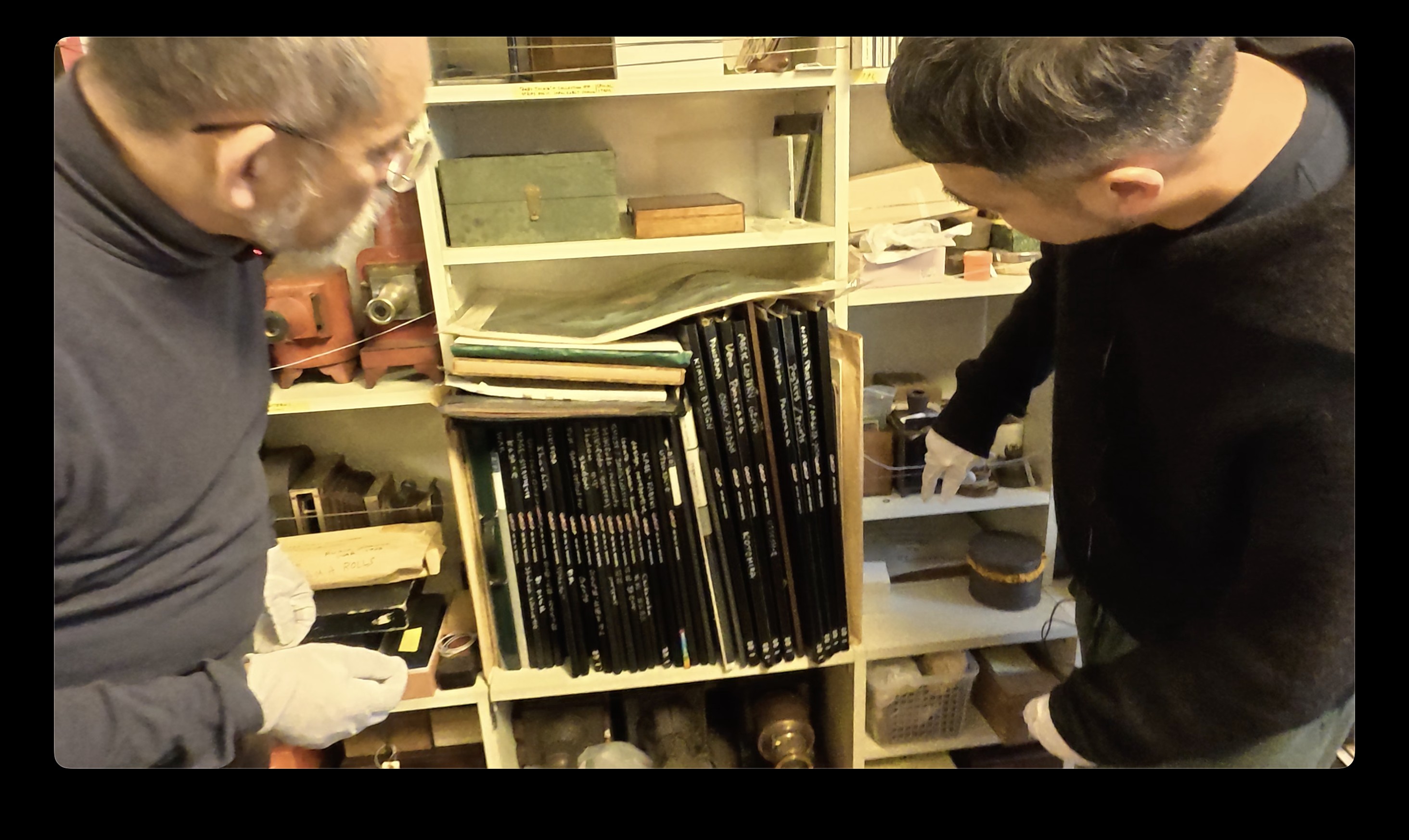
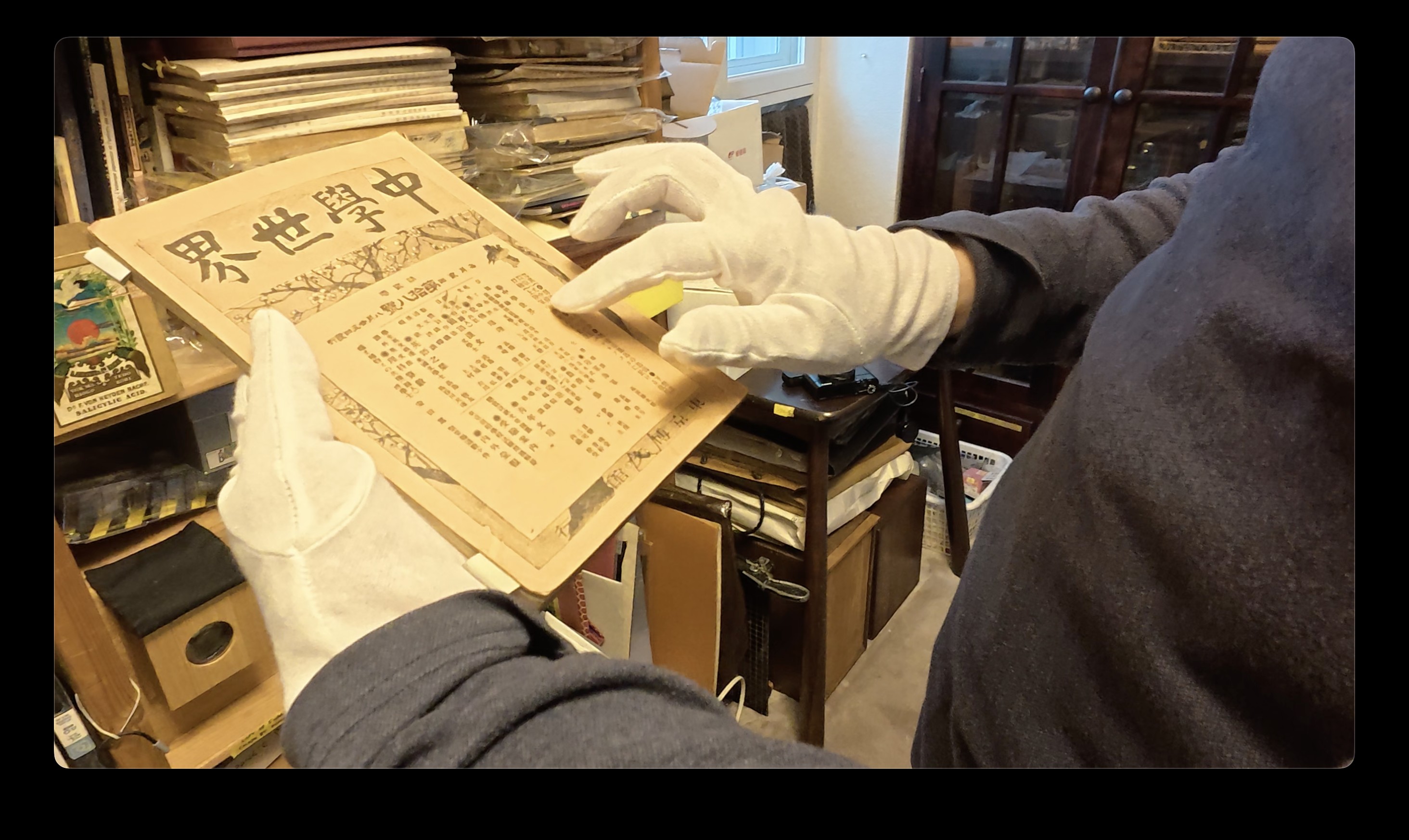
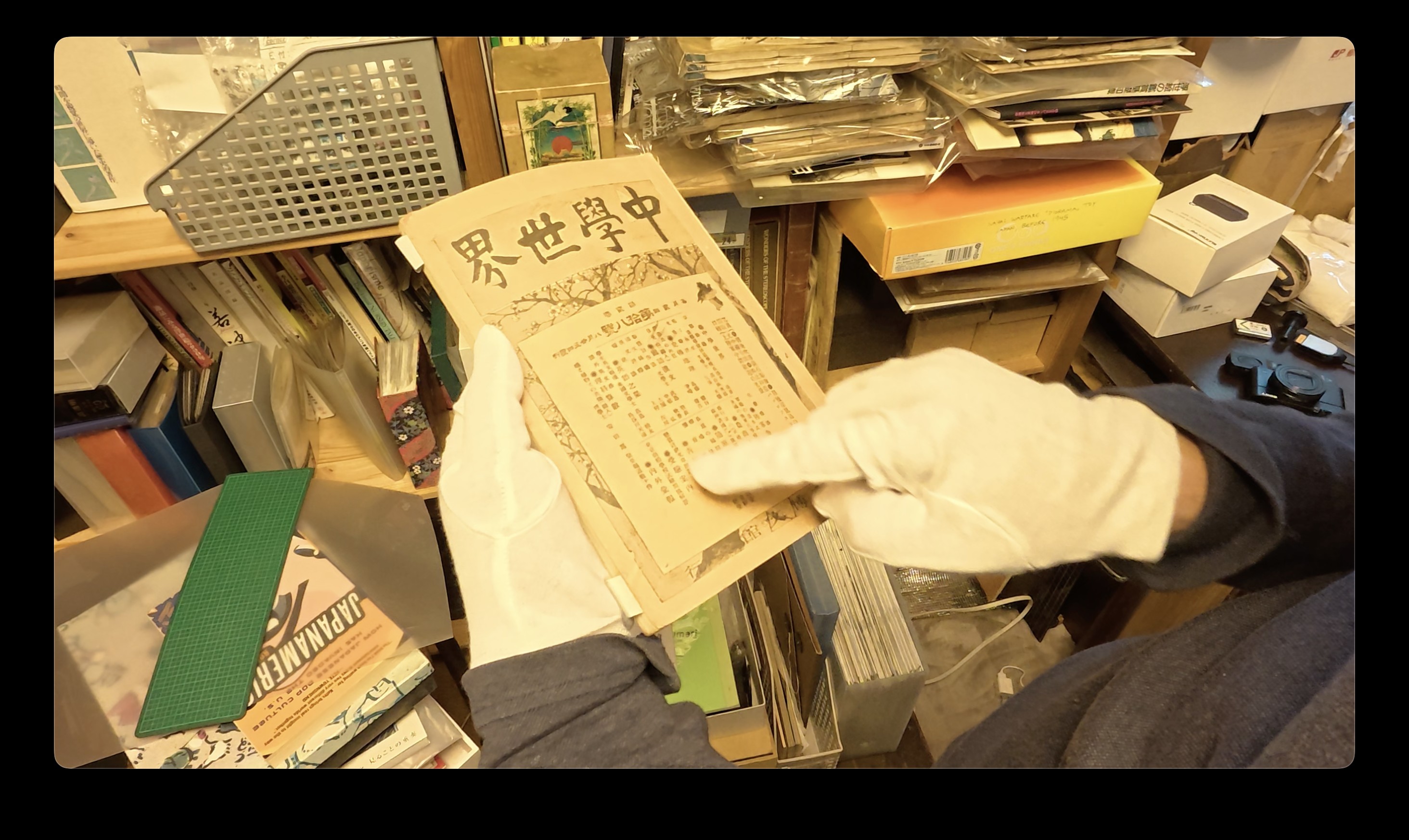
Kusahara's collection has, first of all, many lenses as physical objects, which are themselves extremely fascinating. But on the other hand, she has also gathered an enormous number of documentary materials for understanding these physical objects. For instance, right in front of us are back issues of *Chūgaku Sekai* and *Shōnen Sekai*, magazines. From the 1880s through the 1890s, a genre of boys' magazines was born, and these magazines contained not only amusing fiction but also an abundance of scientific knowledge and enlightenment content. They included explanations of how magic lanterns worked, introductions to new optical toys, and so on. By the 1890s, when cinema appeared, they also included easy-to-understand explanations of how "moving pictures" were projected.
We find physical objects interesting, but it becomes even more enjoyable when we understand how people of that era found them interesting. Kusahara has collected many period documents for this reason. Today, you can view back issues through the National Diet Library's digital archive, but opening actual magazines and seeing what's in the table of contents and what articles are arranged there is special. Let me open one volume. This is *Shōnen Sekai* from Meiji 32—this is quite old. Let's look at the *Chūgaku Sekai* in front of us. Looking at the contents, alongside literary articles there's a section called "Science and Mathematics," with articles like "Symbiosis Between Ants and Plants." Scientific experiment articles and explanations of optical toys like these were frequently published in boys' magazines of that era.
Scientific Enlightenment Magazines of the Meiji Era: "Chūgaku Sekai" and "Shōnen Sekai"
Dominique Chen
Were these magazines commercial publications for the general public? Or were they something schools recommended?
Hosoma Hiromichi
They were publications that children themselves enjoyed buying and reading. The publisher was Hakubunkan, a major publishing house of the time. They profited greatly by publishing things like the Tōyō Diary, a daily journal, and photographic collections of the Russo-Japanese War. The magazines *Chūgaku Sekai* and *Shōnen Sekai* were among their publications.
Dominique Chen
Were they bestsellers?
Hosoma Hiromichi
By reading these magazines, children acquired all sorts of extra knowledge beyond school studies—for instance, understanding how a magic lantern works, or learning how to view an image in an interesting way. That was the educational value.
Dominique Chen
Can you think of something equivalent in modern times? I'm reminded of things like Gakken's "Science for Adults," magazines with special supplements included.
Hosoma Hiromichi
"Science for Adults" originally derived from a magazine called "Science and Learning" for elementary schoolers. Long ago, it was sold at schools, and I myself was an avid reader. The supplements were quite attractive, and I remember learning a great deal from them.
Dominique Chen
In this Meiji era, did magazines with supplements not yet exist?
Hosoma Hiromichi
They would appear a bit later. First, paper-based supplements began to emerge. For instance, when picture postcards became popular, they would be stitched in with perforated lines for cutting out. For larger formats, folded game boards would be inserted. There were things like "science sugoroku" and "famous place sugoroku"—games where you could reach a goal after completing scientific experiments, or travel to various famous sites. That sort of thing.
Dominique Chen
Modern "Science for Adults" includes supplements with magic lantern parts and so on that you assemble yourself. Did magazines of that era have similar supplements where you could actually make things?
Hosoma Hiromichi
Those came a bit later as well. They definitely existed in the pre-war Showa period. What I've seen is something called "Make Your Own Zoetrope." Of course, it wasn't practical to include three-dimensional parts directly, so they were made of paper and folded. You'd cut along the perforated lines and assemble it to create an optical toy. So the culture of magazine supplements goes back quite far into the pre-war era.
Dominique Chen
That's interesting!
Hosoma Hiromichi
In that sense, the fact that there are simply so many paper materials is a major characteristic of this collection, and I'd like to explore that a bit further.
Supplement Culture of Magazines—The Breadth of Paper Materials
Hosoma Hiromichi
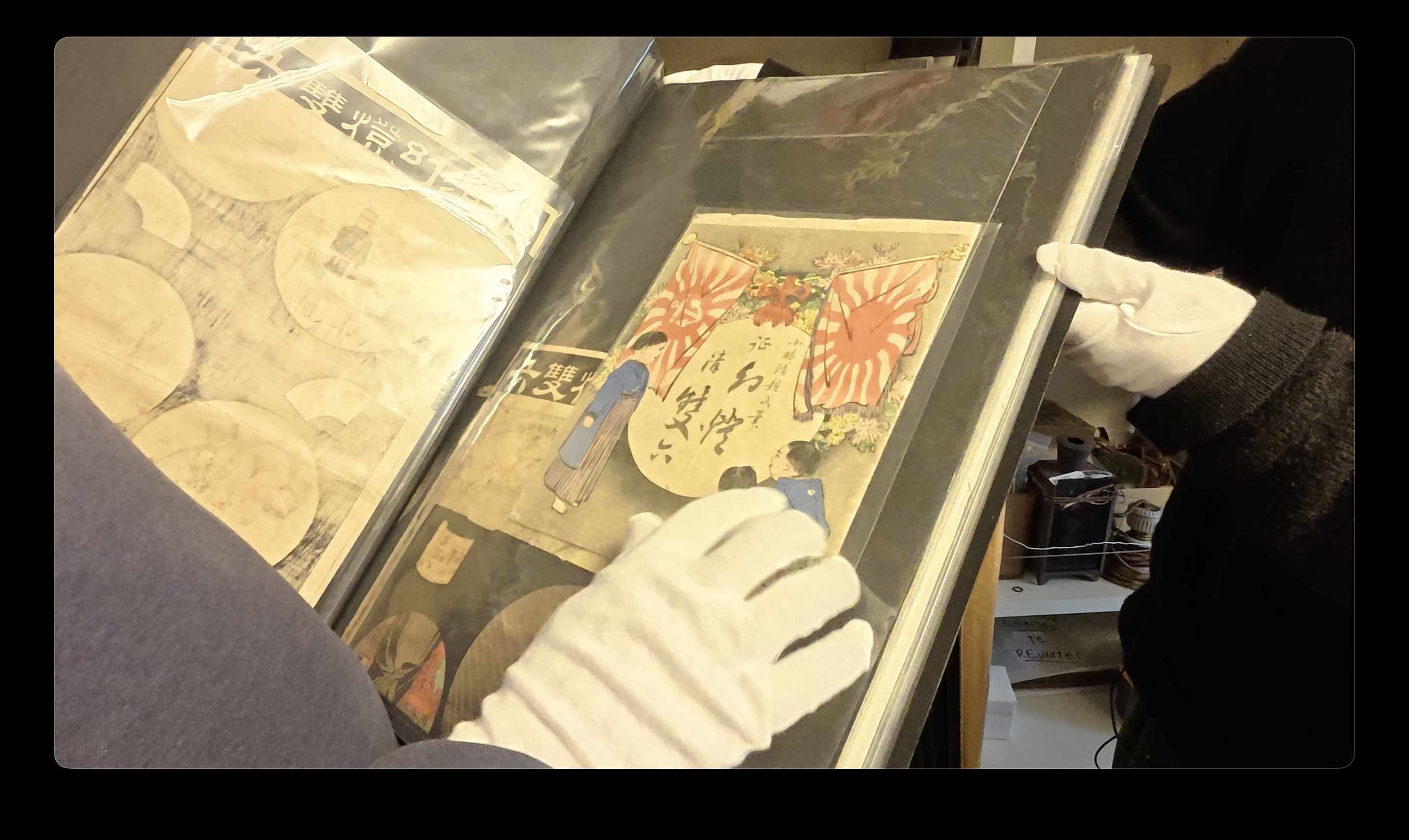
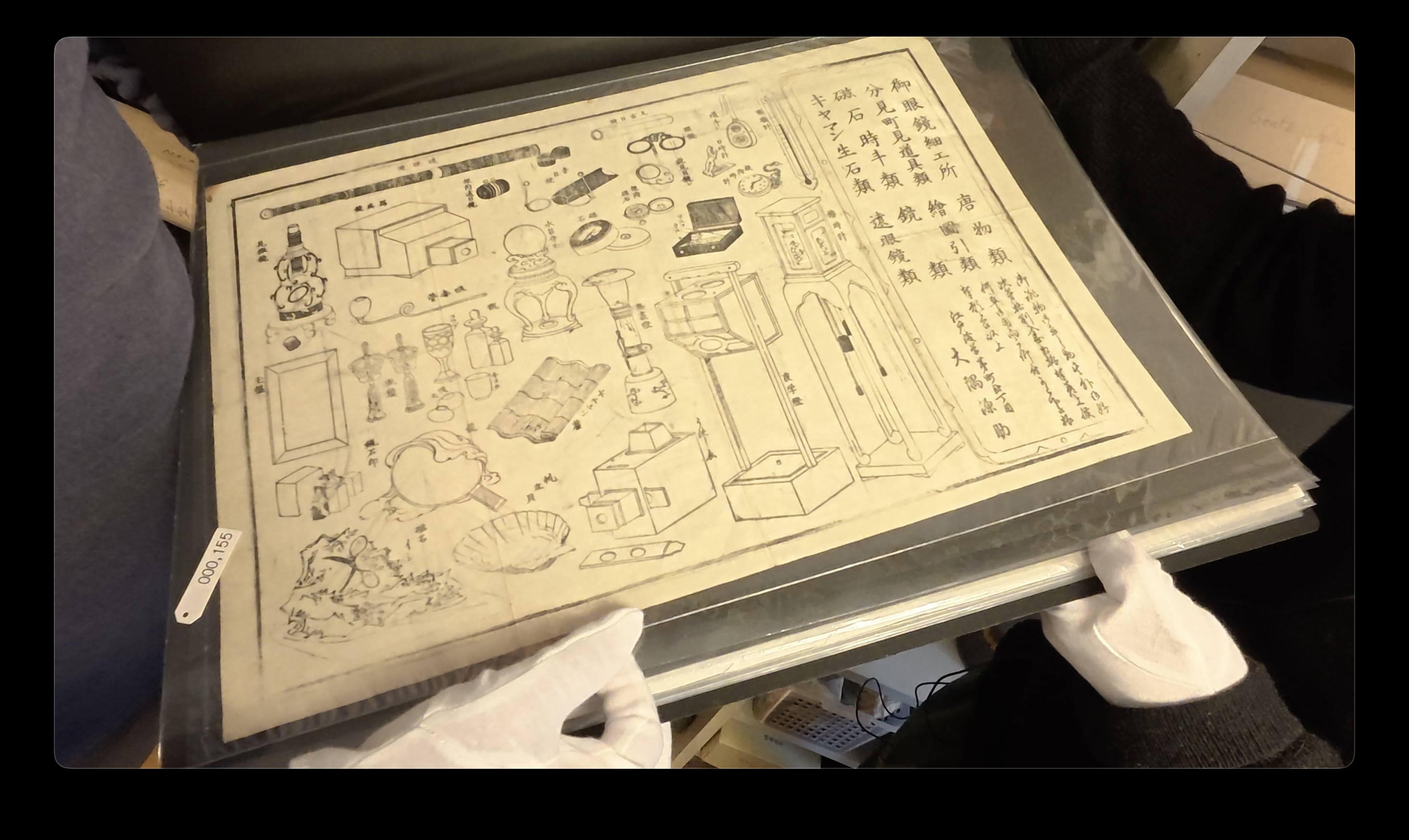
The paper materials in the collection include various types. Woodblock prints and advertisements depicting magic lanterns. For instance, there are advertisements for magic lanterns. Beyond the magic lanterns themselves, there are also designs that use the image of the round beam of light projected by a magic lantern as a motif—a design element. The works of Kobayashi Kiyochika—a famous artist known for creating optically-influenced prints—are also included. Furthermore, there are also catalogs of various lens-related items.
Dominique Chen
I see notations like "Foreign Goods" and "Mirrors."
Hosoma Hiromichi
There's "Glass and Stone Objects," and also "Telescopes." "Telescopes"—that's a nice way of referring to them. Lens items appear scattered throughout the catalog. The fact that these optical devices are cataloged together like this gives us a sense of the arrival of a new era. It's quite striking.
Magic Lantern "Furiwake Sugoroku"
Dominique Chen
What is this?
Hosoma Hiromichi
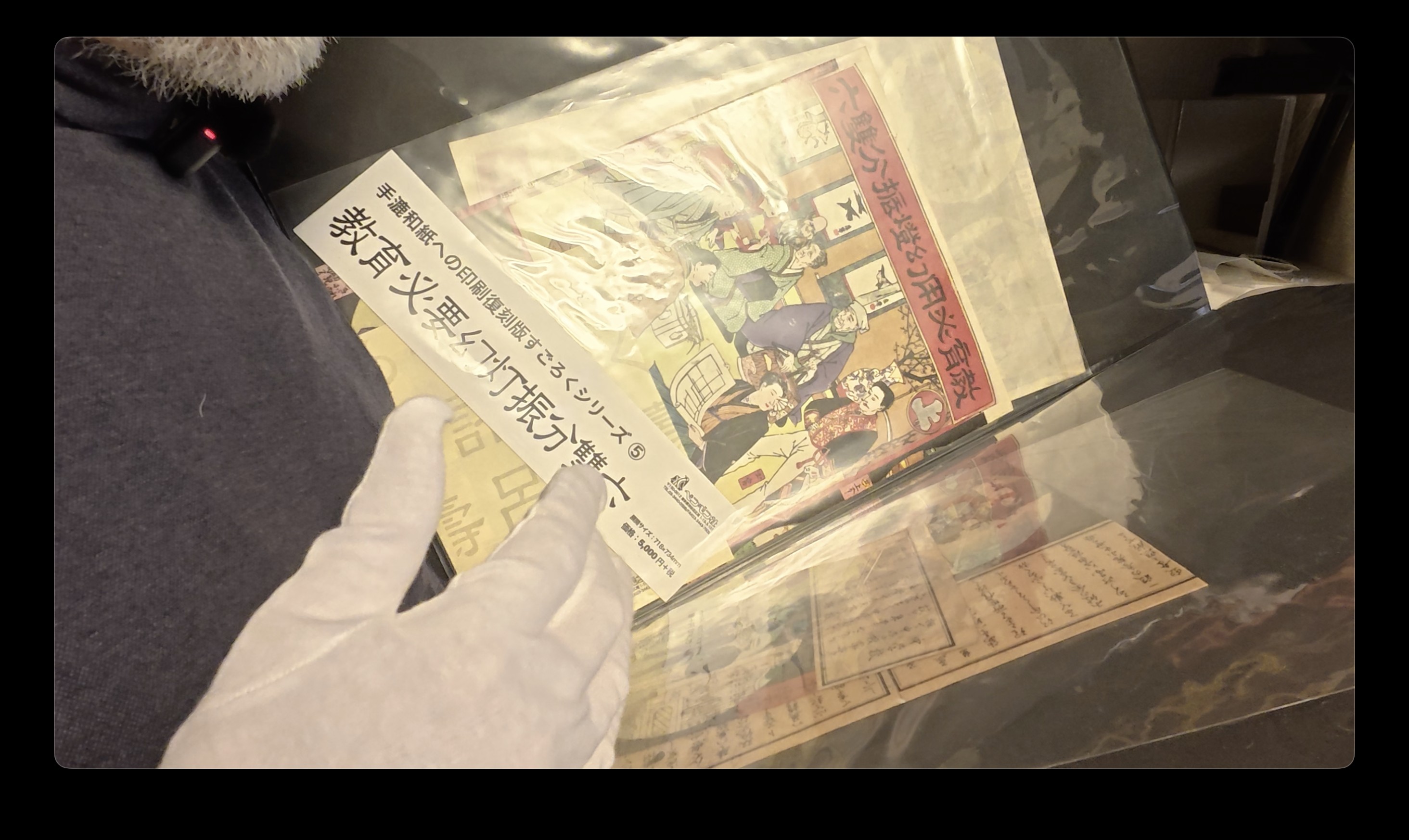
This is a sugoroku game board. There's a type called "furiwake sugoroku," where human fate is divided left-right or up-down, and depending on the dice roll, you could end up in hell or heaven—that's the game. This is a version of that, labeled "Magic Lantern Furiwake Sugoroku." I suspect that each square on the game board had the circular shape of a magic lantern's projected image.
Dominique Chen
Why don't we unfold it and take a look?
Hashimoto Norihisa
It's a facsimile.
Hosoma Hiromichi
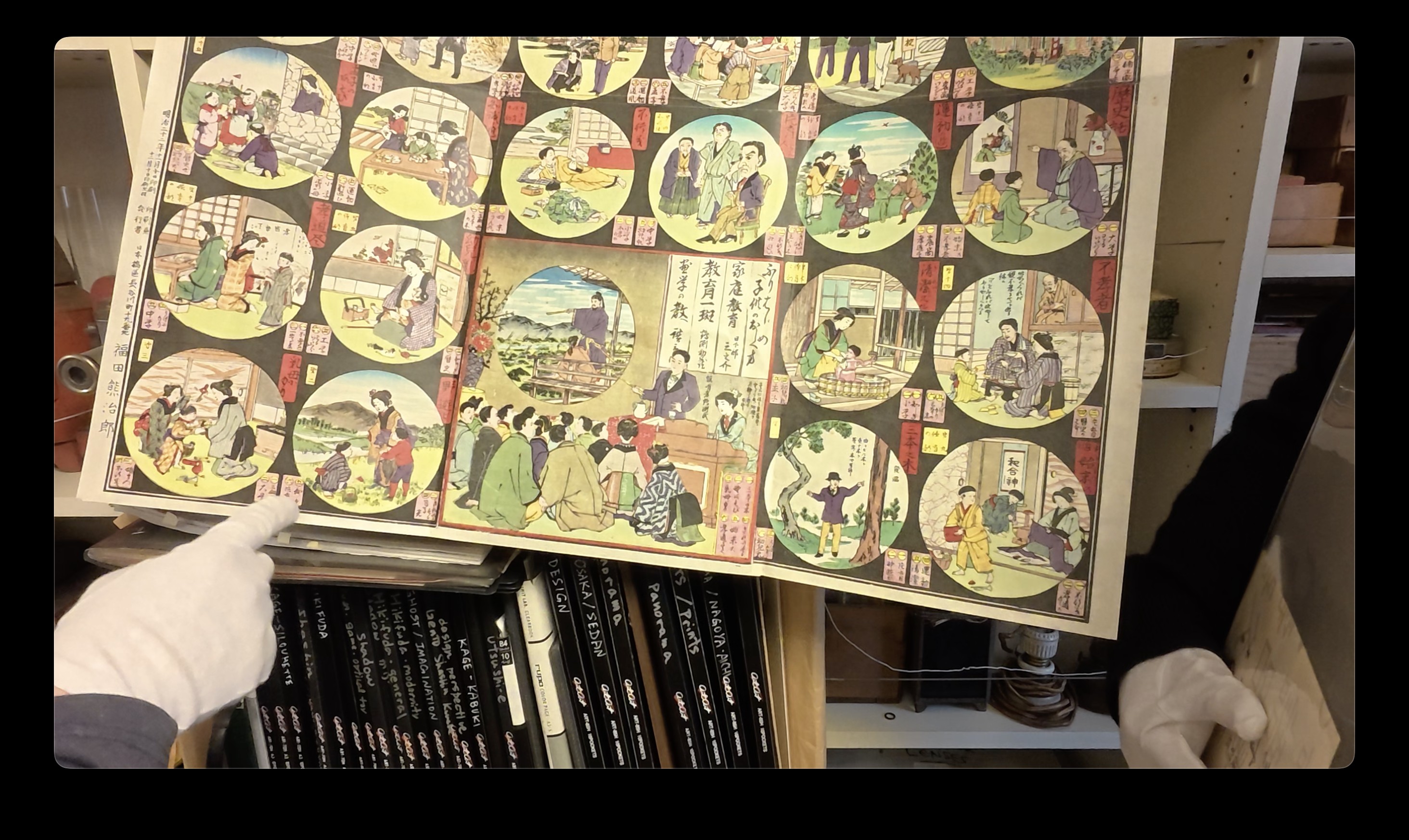
It's a facsimile, but it's sufficient for understanding what's depicted. Let me explain a bit before we unfold it. The idea is "This is how you understand the world," and while it uses magic lanterns as a motif, what's actually depicted is the images of various great historical figures. It starts with school, and as you progress upward, you might become Ono no Imoko or Sima Guang—in other words, as you leave school and progress, you become increasingly distinguished. It's a game asking "What will you become when you grow up?"
Dominique Chen
You can really feel the sense of education in a nation-state here.
Hosoma Hiromichi
[unfolding the sugoroku] Here it is. Furiwake sugoroku typically begins from the bottom, and here is the starting position. A picture of a child is drawn, showing the scene of being taught by a teacher. We begin with something innocent like outdoor play or familiar everyday scenes. These dice rolls are written here with instructions like "If you roll a 1, advance to Three-Stemmed Tree," and words like "Careful Living" and "Restoration."
Dominique Chen
Unlike modern sugoroku or games of life, there's no pathway drawn, is there?
Hosoma Hiromichi
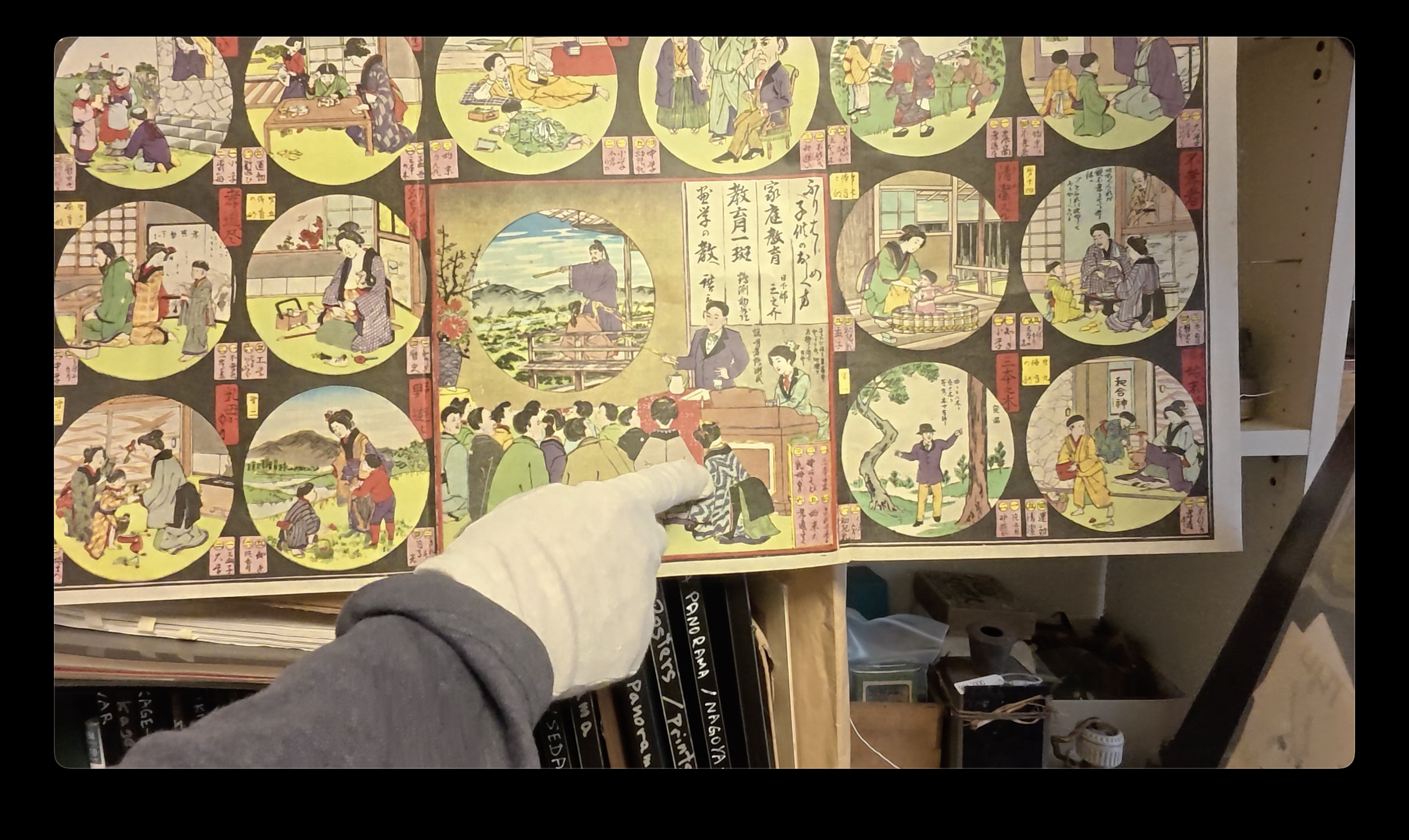
That's right. This is called "jumping sugoroku," where you don't necessarily advance in order. Depending on what you roll on the dice, you can jump to various places. Among the squares arranged on a flat surface, for instance, rolling a one might take you to "Three-Stemmed Tree." Then at Three-Stemmed Tree, you roll again and go to another location. If you're unlucky, you might land on "Unfortunate Person."
Dominique Chen
It's like a game book, in a sense.
Hosoma Hiromichi
Something like that. The path is quite long, and it takes a while even to reach elementary school. Finally you reach primary school, and if you roll lucky with a 2, you can jump to university. That seems a bit excessive, honestly.
Dominique Chen
"Engineering" is positioned right in the center.
Hosoma Hiromichi
Indeed—engineering was an ideal path. Like William Barton and others, becoming a professor at an engineering college, that is, becoming an engineer, was one ideal career path. Eventually you become a great person. Reaching the very top, you might become an engineer, a merchant, a farmer, various professions, but the goal is always to become a respectable adult living a comfortable life afterward. There's even a curious route where Washington becomes the end result.
Dominique Chen
There's Washington and Sima Guang both. It's an East-West fusion.
Hosoma Hiromichi
Great people from various countries are mixed together. You can go all the way to Washington and then fall back to middle school again. There's even a route from Washington to Mori Ranmaru. Rather than Oda Nobunaga, they chose Ranmaru, which is interesting.
Hashimoto Norihisa
Does everyone eventually reach the goal?
Hosoma Hiromichi
Once you reach the goal, there's nothing after it, so it ends. To get there involves many twists and turns, and you move backward at times too. Even with five people playing, you might see four people finish while one person is still wandering around. Some children would wait for everyone to finish, while others might just give up once one person reached the goal.
Dominique Chen
The selection of great people is unique.
Hosoma Hiromichi
There's even "The Wife of Ichitoyoshi." The inclusion of female great figures suggests that girls also played this game together.
Hashimoto Norihisa
So landing on "Unfortunate Person" doesn't mean the game ends?
Hosoma Hiromichi
Even if you land on "Unfortunate Person," you can return to Three-Stemmed Tree and start over again. There's a path to redemption.
Hosoma Hiromichi
And each square is cut in a circular shape. In other words, the scenes from the magic lantern are laid out for viewing all at once.
Dominique Chen
It has the flavor of the opening of Japan to the world.
Hosoma Hiromichi
Although the content barely relates to magic lanterns at all (laughs).
The Spirit of Panoramic Vision—Points of Connection Between Sugoroku and Panoramas
Hashimoto Norihisa
Various images emerge one after another before your eyes.
Hosoma Hiromichi
You could say that the scenes in this sugoroku are similar to a "magic lantern show." While there's no magic lantern machine, there's a narrator, music played on an organ—accompanied by narration and music just like a silent film. And there are the images from the magic lantern, with various educational commentary. It has that atmosphere of a magic lantern show.
Hashimoto Norihisa
The audience depicted seems to be adults?
Hosoma Hiromichi
Both adults and children are watching. You can see young adults too. It doesn't really have the feel of being aimed only at children. Another interesting aspect is that the sugoroku is laid out as a panorama. From start to finish, you can see everything at once, and you can grasp the whole of human life at a glance. This sense of "panoramic vision"—the feeling of grasping the whole at a glance—is, I think, an important visual spirit of the Meiji era.
Dominique Chen
The layout resembles a Buddhist mandala. It's arranged symmetrically.
Hosoma Hiromichi
Actually, furiwake sugoroku didn't begin in the Meiji era but rather came from China and the Korean peninsula during the Edo period, and was already circulating widely by the end of the Edo period. This is its Meiji version.
Dominique Chen
So it uses the magic lantern as a motif and constructs the imagery in circular form.
Hosoma Hiromichi
In both the Meiji and Edo eras, there was a desire to get a comprehensive overview of something. That desire became crystallized in these forms of visual culture.
Hosoma Hiromichi
Since this is a facsimile, the paper quality is good, but I can really see how Kusahara spent time thinking while looking at things like this.
Expansion into Panorama-Related Materials
Hosoma Hiromichi
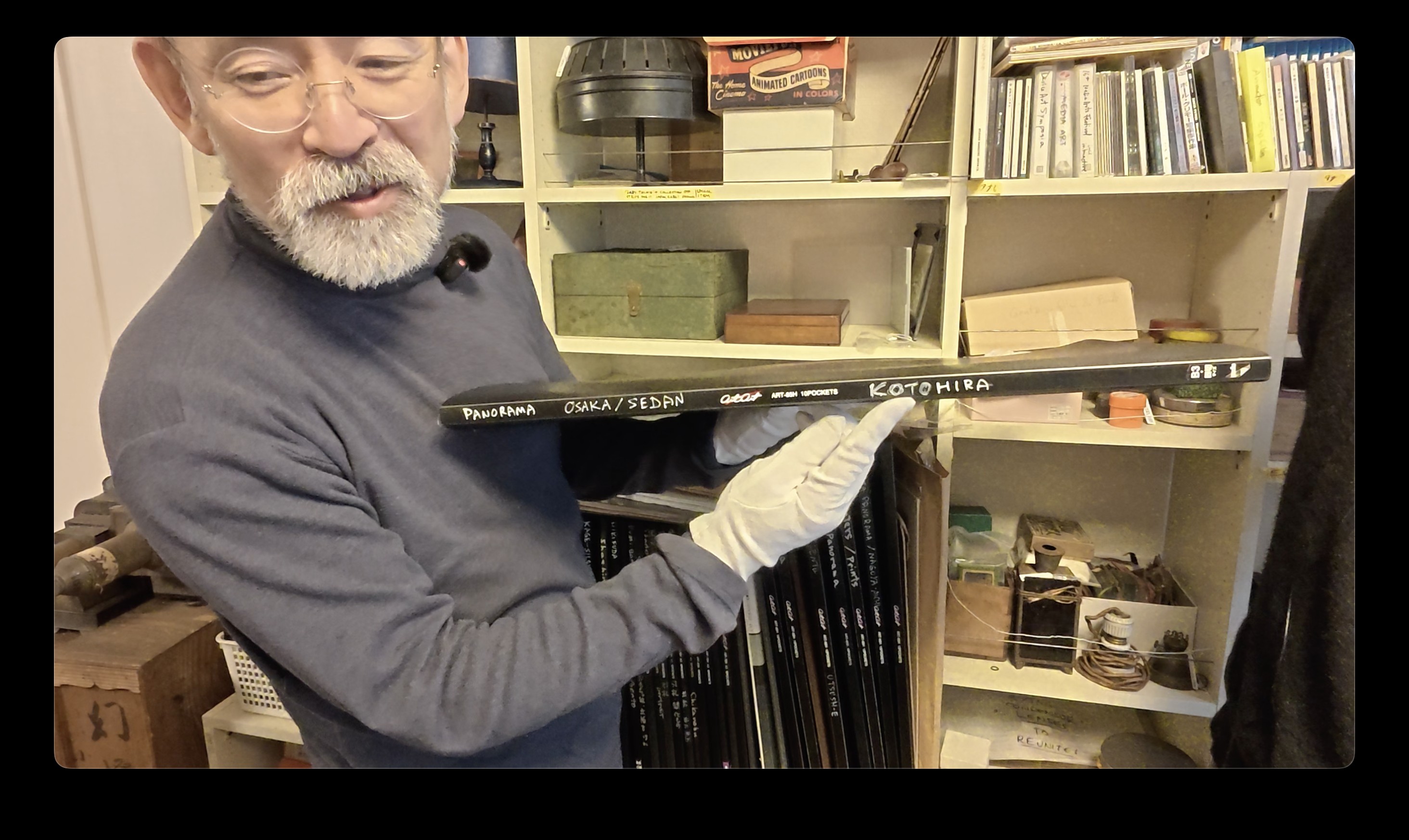
Now, looking at this section of the bookshelf, you can immediately see that there are many large pictures, but what I particularly want to focus on is the panorama-related materials.
Hosoma Hiromichi
The reason is that around 2020—sometime after I came to Waseda—I spent a long time talking about panoramas with Kusahara at a coffee shop near the Museum of Photography in Ebisu. Panorama halls were invented in the eighteenth century and became extremely popular in the nineteenth century. Panorama halls were built in various places, and many were constructed in Japan as well. Kusahara has visited panorama halls all over Europe, and while I've visited most of the surviving panorama halls in Europe, no matter what I talk about, she responds with "Well, you see..." I've never seen anyone with such enthusiasm for panoramas.
Hosoma Hiromichi
Evidence of this extraordinary passion for panoramas is visible here. The representative panorama halls in Japan are those in Asakusa and Ueno, and many documents about them remain, with numerous panorama pictures. Artists of the Goseda school and many other painters produced panorama paintings. But the issue is that not only Tokyo panoramas but also various panoramas existed in the provinces. Provincial panorama pictures are rarely circulated and difficult to obtain. Yet Kusahara has panorama pictures of Narita, Nagoya, Aichi, Osaka, Sedan—this is probably the French Sedan—and Kompira, types of panorama pictures that even passionate panorama collectors rarely possess.
Hosoma Hiromichi
Why I'm drawn to them is because there was a panorama hall at Tennoji in Osaka, but what was actually inside it isn't really well known. And then there's the Sedan panorama, which appears in Mori Ogai's diary—Ogai saw the Sedan panorama, as mentioned in his diary. Maeda Ai—the Maeda Ai of "Literature in Urban Space"—has written quite extensively about that panorama. For those who studied urban theory in the 1980s, the Sedan panorama would be something that piques interest.
Dominique Chen
This one here?
Hosoma Hiromichi
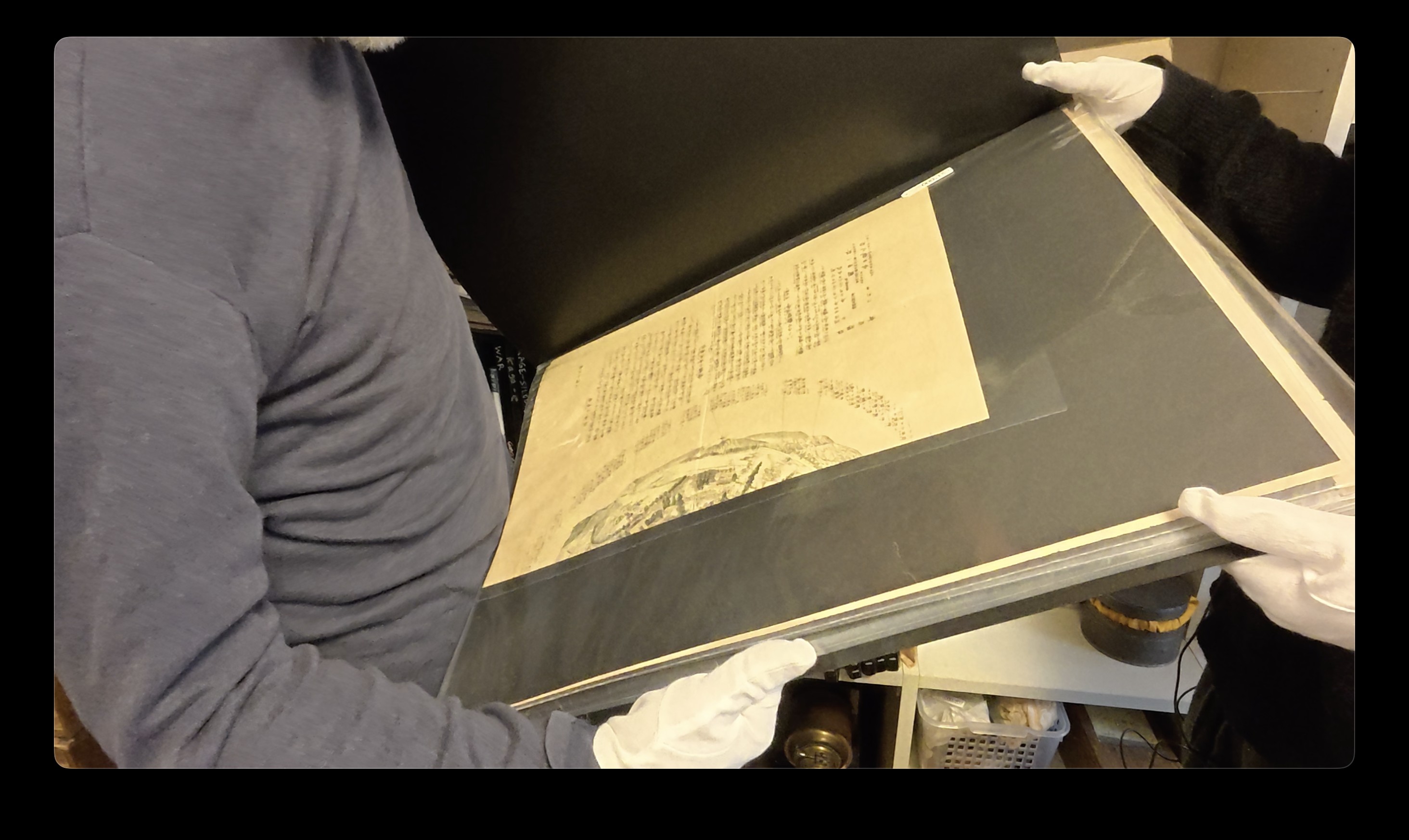
This is where I get quite excited. There are several types of pictures that were distributed at panorama halls. The typical ones are these circular forms. What's depicted inside the panorama hall is drawn as a circle, an overhead view looking down from above. I believe this is likely a panorama picture from the Osaka panorama hall. You can see the character "Nanba Shinchi" written on it.
Dominique Chen
Let's unfold it and take a closer look.
Hosoma Hiromichi
I think this is quite valuable material. Let's unfold it.
Dominique Chen
Let's take it to the photography booth and examine it carefully.
Hosoma Hiromichi
I've said various things, but what I really want to focus on among the panoramas are these: Osaka, Sedan, and Kompira—that is, Konpira. These panorama pictures seem rather suspicious to me. I would like to select these.
Dominique Chen
Then let's take them to the photography booth.